

Quick Summary
For most Chicago practices, an SBA 504 loan requires about 10% down versus 20–25% for a conventional commercial loan — on a $2,000,000 building, roughly $200,000 instead of $400,000. The SBA route also carries a long fixed rate and requires you to occupy at least 51% of the space. Conventional loans suit buyers with more capital or pure investment goals. The right choice follows the location decision, not the other way around.
Why Listen to Us
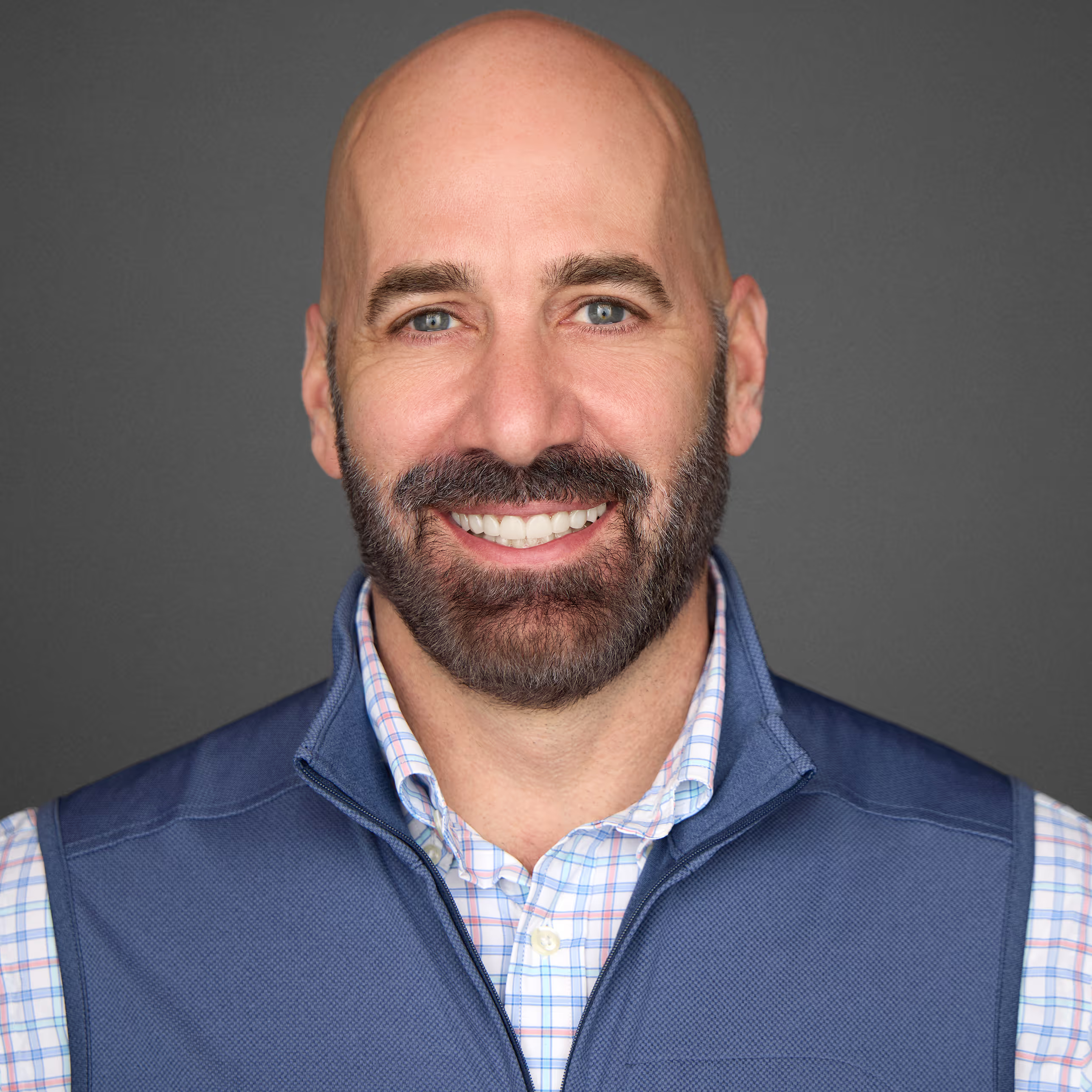
Mike Wolson is a commercial real estate broker and an Illinois-licensed attorney, rated 4.9 across 71 Google reviews. Most brokers hand the numbers to the buyer's accountant. As founder of +CRE, affiliated with Compass, he represents dental practices, healthcare providers, and service businesses across Chicago and its suburbs — tenants and buyers, never landlords — and treats financing and the buy-versus-lease decision as one question, answered before you commit.
The Bottom Line Up Front
For a healthcare practice, the decision to buy its building often comes down to one question that has nothing to do with real estate and everything to do with financing: how much cash do you have to put down, and how much will the payments be? The answer usually turns on a choice between two paths — a conventional commercial loan or an SBA 504 loan.
Both can finance the same building. They produce very different outcomes for how much capital a practice ties up and how much flexibility it keeps. This guide explains the two, side by side, for dentists, physicians, and healthcare operators evaluating a purchase in Chicago and the suburbs.
This guide covers:
- How each loan is structured
- The down payment gap — and why it is the whole story
- Rates, terms, and what a fixed rate is worth
- The occupancy rule that makes owner-users eligible
- How lenders actually evaluate the deal
- Which path fits which practice
The Two Structures, Plainly
A conventional commercial loan is a single loan from a bank or credit union, secured by the property. It typically finances 75–80% of the purchase, leaving the buyer to fund 20–25% as a down payment. Terms and amortization vary by lender, and rates may be fixed for a period then reset.
An SBA 504 loan is not one loan but a structured combination. A conventional bank loan covers about 50% of the project, an SBA-backed debenture (issued through a Certified Development Company) covers about 40%, and the borrower funds roughly 10%. The SBA portion carries a long, fixed rate. The program exists specifically to help small businesses acquire the real estate and equipment they operate from.
The Down Payment Gap Is the Whole Story
The single most important difference between these two paths is the cash required at closing. On a $2,000,000 building:
- Conventional at 80% LTV: roughly $400,000 down
- SBA 504 at 90%: roughly $200,000 down
That $200,000 difference is not abstract. For a practice, it is a hygienist's salary for years, a second operatory, an imaging suite, or the working capital that carries the business through a slow quarter. The owner-occupied practice that chooses the SBA route keeps that capital in the business rather than locking it into the building. This is why, for many first-time buyers, the SBA 504 is not merely the cheaper option — it is the option that makes buying possible at all.
Rates, Terms, and the Value of a Fixed Rate
The SBA debenture portion is known for a long, fixed rate, which removes interest rate risk from a large share of the debt over a long horizon. In a rising or uncertain rate environment, that predictability has real value: a practice can model its occupancy cost for decades without wondering what a reset will do to its payment.
Conventional loans vary more. Some offer fixed periods that reset after five or ten years; others are fixed for the term. The amortization schedule matters as much as the rate — a longer amortization lowers the monthly payment and improves debt service coverage, but builds equity more slowly and costs more interest overall. When comparing offers, the honest comparison is the full payment over the holding period, not the headline rate.
The 51% Occupancy Rule
The SBA 504 program requires the business to occupy at least 51% of the building. For a healthcare practice, this is rarely a constraint — most practices occupy their whole space. What it also permits is powerful: a practice can occupy 60% and lease the remaining 40% to a complementary provider, generating income that offsets the mortgage while still qualifying for the program. This is the owner-occupied model working at its best — the building serves the practice and pays for part of itself.
Conventional loans have no such requirement, which makes them the route for pure investment properties. But for an owner-user practice, the occupancy rule is a feature, not a limitation.
The Costs Beyond the Rate
A financing comparison that stops at the interest rate misses real money on both sides. The SBA 504 program carries upfront fees folded into the loan, plus prepayment penalties that decline over the early years — so a practice that might sell or refinance soon should weigh those carefully. Conventional loans avoid SBA fees but often demand the larger down payment, a shorter fixed-rate period, and sometimes a faster balloon. There are also costs common to both: appraisal, environmental review, title, and legal. The honest way to compare is total cost of capital over your expected holding period, including the opportunity cost of the down payment — the return that money could earn if it stayed in the practice instead of the building.
This is also where the debt service coverage ratio quietly shapes the deal. A structure that lowers the monthly payment — a longer amortization, or the SBA's long fixed term — improves DSCR, which can be the difference between an approval and a decline for a practice whose numbers are solid but not spectacular.
How Lenders Evaluate the Deal
Whichever path you choose, a lender underwrites the same fundamentals:
- DSCR: does the income cover the debt with a cushion? Lenders typically want 1.20–1.35. For an owner-user, they weigh both the rent the practice pays and the strength of the practice itself.
- LTV: calculated on the lower of price or appraised value. A low appraisal can raise the cash required at closing.
- Practice financials: collections, profitability, the owner's credit, and often a personal guaranty.
- The building itself: condition, location, and reuse value if the practice ever leaves.
Because the tenant and the borrower are the same entity in an owner-occupied deal, lenders scrutinize the practice as closely as the property. Getting the financials organized before applying is half the battle.
A Common Mistake: Optimizing the Loan Before the Location
Practices sometimes get so deep into financing structures that they optimize the loan before confirming the building is the right long-term home. This is backward. The most favorable SBA 504 terms are worthless if the location is wrong, the space cannot grow with the practice, or the neighborhood is trending the wrong way. Financing is the last question, not the first. The order that protects a practice is: is this the right location for the next ten to fifteen years, does buying beat leasing on the numbers, and only then, which loan structure funds it best. A broker who represents you as a buyer keeps that sequence straight; a lender, understandably, starts with the loan.
It is also worth remembering that the two paths are not mutually exclusive over time. A practice can buy conventionally now and refinance into better terms later, or start with an SBA 504 and refinance out once the prepayment penalty burns off. The financing decision is not permanent — the location decision effectively is.
Which Path Fits Which Practice
Neither loan is universally better. The fit depends on the practice:
- SBA 504 suits practices that want to preserve capital, value a long fixed rate, and plan to hold the location for years. The lower down payment is decisive for many first-time buyers.
- Conventional can suit practices with ample capital that prefer a simpler, faster process, want to avoid SBA fees and prepayment penalties, or intend to buy purely as an investment without occupying the space.
The decision also belongs inside the larger buy-versus-lease analysis. Owning only makes sense when the location is right for the long term and the numbers work — which is exactly the ground covered in our guide to cap rate and NOI for practice owners. If you are still weighing the two, start with leasing vs. buying in the Chicago suburbs, and if this is your first space, how dentists finance their first practice space.
How Plus CRE Helps
Plus CRE represents practice owners as buyers, never landlords or lenders. Our buyer representation and healthcare advisory work helps dentists and healthcare providers structure the purchase the numbers actually support. Talk to us before you commit to a financing path.
Frequently Asked Questions
How much down payment does an SBA 504 loan require?
Typically about 10% of the project cost, compared with 20–25% for a conventional commercial loan. On a $2,000,000 purchase, that is roughly $200,000 versus $400,000 — the capital difference that often makes buying feasible for a practice.
Can I rent out part of a building bought with an SBA 504 loan?
Yes. The program requires your business to occupy at least 51% of the space, so you can lease the remainder to another tenant. Many practices use this to offset the mortgage while still qualifying.
Is an SBA 504 loan always cheaper than a conventional loan?
Not always. The down payment is lower and the SBA portion carries a long fixed rate, but there are SBA fees and prepayment penalties in the early years. The right comparison is total cost over how long you plan to hold the building, not the headline rate alone.
What credit score and financials do I need to qualify?
Lenders look at the practice's collections and profitability, the owner's personal credit, and debt service coverage, usually alongside a personal guaranty. Strong, well-organized financials matter more than any single number. Requirements vary by lender.